
Collaborators
We worked on this assignment with Maurits Dijkman, Bianca Filip, Ewoud Janus, Emilia Pavel, Rebecca van der Lee, and myself of course. As this assignment was done in a group context there are no specific parts I can take full ownership of as they were all performed in a group setting.
Case Description
Domestic pets (e.g., cats & dogs) often experience stress and separation anxiety when left alone. While interactive toys exist, the effectiveness of these solutions varies per individual animal; a motion that is engaging for one might be terrifying for another. This makes designing an effective robot companion challenging.
To solve this design gap, this project tries to focus on developing a modular pet companion toolkit. Rather than a single, static robot, we design a hardware and software setup that allows designers and pet owners to rapidly prototype, test and change according to the preferences of each individual pet. Research argues that robots in animal studies should not just be static, but rather that they should be a dynamic agent that reacts to the animals behavior cues [1]. Swapping physical modules, like a treat dispenser, a laser pointer, or a mechanical arm to throw balls, facilitates iterative testing. The goal is to discover the best combination of play and mechanics to effectively reduce pet anxiety.
Leading us to the research question:
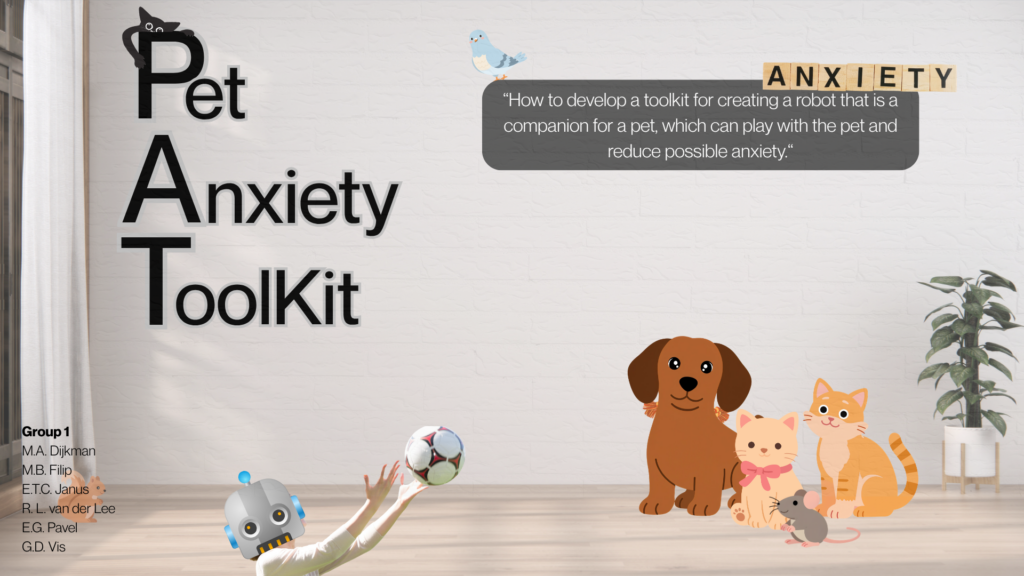
"How can a modular robotic design toolkit enable designers and pet owners to rapidly prototype interactions to help alleviate anxiety behaviours for domestic pets? "
Literature desk research
HRI Grounding
Before we develop this concept further I looked into literature related and useful for our case and intended design. When looking into research around robot dog interactions, related works show that a lot of initial negative reactions to robots from dog specifically comes down to the way that they are approached. When the speed of the robot is too high and the robot makes too much noise a large part of the dog participants react negatively to the robot [2].
Research also highlights that robots should interact with the dog in a playful way, displaying social cues and behaviors that are familiar to the dog [3]. Correia et al. also highlight once again that the robot should apply multimodial communication and that the robot should adapt its behavior to the dog. The dog should also be able to end or start the engagement with the robot according to its own needs.
Mundell et al. worked on a case study where they created an intervention to reduce separation anxiety within dogs. This paper is highly relevant to our case, as it shows the feasibility of using a machine learning computer vision machine learning model which can be applied to effectively reduce separation anxiety in combination with a positive reinforcement mechanism [4].
An important overreaching remark is also that the while our tool is intended for pets, it can also be valuable in making HRI in general more inclusive. Mancini talks about how research into Animal Robot Interaction (ARI) could give us insights into how we can develop technologies for individuals who are not able to communicate through natural language. Developing this tool might provide us with insights that are not ARI specific [5].
Adjacent Field Literature
Although the work of Fogelson et al. is focused on reducing loneliness and depression in humans by providing them with robotic dog or cat companion, it might still be relevant for our case. Their work shows that providing older adults with such a companion can reduce depression and anxiety within the research participants [6]. We believe that this concept might also transfer to pets. We hypothesize that by providing them with a robotic companion, anxiety might also be reduced.
The research of Okita et al. further reinforces this, showing that robot companions can be used to reduce anxiety within pediatric patients. Their research provides us with a second interesting insight, which is that they found the robot companions to be more effective when a parent/guardian was present [7]. At this part of the process we therefore identified that the owner of the pet should be collaborating with the robot. Not having the robot just replace the owner when they are gone, and "hiding" when they arrive home again might reduce the effectiveness of the design. This is further supported by the work of Westerlaken and Gualeni as they also propose that animals should be included in the design process. They explore research through design by making animals participants in the design research. Actively including them provides a design that aligns with the needs of the animal [8].
As explained in the work of Donald A. Norman the way objects look provide us with clues on how they work and what their capabilities are [9]. We should heavily apply this to our toolkit design, humans and dogs have an understanding of how objects should be used. This can be used to inform the design choices of our robot, the components should be easily mounted to the design, but this could also be applied for the shape of a possible ball thrower for the robot for example.
The choice for a toolkit containing different modules is supported by the work of Greenberg and Fitchett. Their work shows a toolkit containing different plug-and-play modules. These modules can be used to rapidly test out different iterations and configurations of in our case a robot [10]. This work reinforces the choice for a toolkit that can be used to configure the robot to its users requirements without needing long turn around times for an iteration.
Design Tools
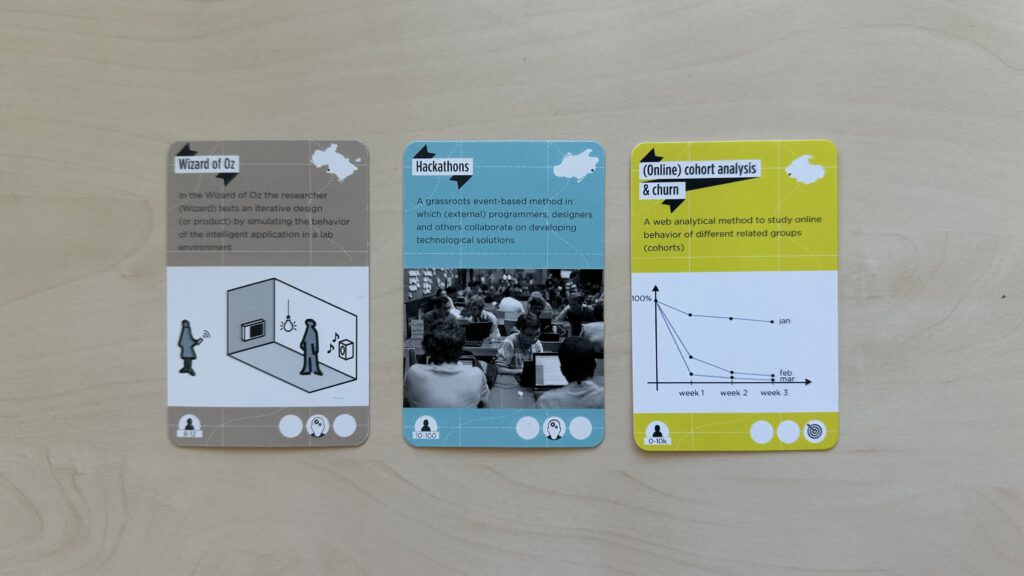
Wizard of Oz
The Method: Testing a product's behaviour by simulating it manually
Application to problem: Before actually making the toolkit and having to decide on speed and the best module applications, construct a low-fidelity version of our robot, attach the modules, and try it out. This allows for quick iteration and is easy to edit.
What we might learn: This part of the design process can help us identify which modules are exciting for the animals and are perceived as play, while other modules could be used to reduce anxiety or loneliness. Certain jerky movements, smells, or shapes can scare the animals. This design method can help find the sweet spot in interactions and engagement, defining the parameters and specifications of the final hardware and software. It also reduces the research time needed and lowers costs. Play methods are translated into actual mechanical design.
Hackathon
The Method: An intensive, timed collaborative event where multidisciplinary research teams rapidly ideate and prototype solutions to our challenge.
Application to problem: Organise a short, one-day event focused on designing a product for animal anxiety reduction and entertainment. Invite peers at the University of Twente, such as design experts and other animal enthusiasts who want to participate, and provide them with all the tools and sensors they need to create a toolkit, challenging them to prototype a module that helps animals feel safe or relaxed.
What we might learn: By observing how other designers and experts tackle this issue and build solutions, we can identify the obvious physical and technical pitfalls in designing for pets, such as issues with durability, scale, and movement. It may also generate a wide range of ideas for our modules that we might not have considered on our own. Furthermore, it allows us to test the toolkit itself and see how intuitive it is and what is missing.
(Online) Cohort Analysis
The Method: A qualitative and quantitative research approach that groups subjects based on shared characteristics to identify patterns.
Application to problem: Engage with and research subsets of pet owners through online forums, networks, or surveys who actively deal with issues like separation anxiety. Segment these cohorts based on variables such as pet background and context (e.g., rescue or raised from birth) or the type of anxiety the animal shows, and analyse how owners currently cope with this issue.
What we might learn: This method helps support our assumptions with data and real experiences from owners. We can learn exactly how owners currently support their anxious pets and what triggers their distress. Mapping observed behaviours to specific interventions we can deploy helps determine the foundations of our modules.
Mindmap of Problem Space
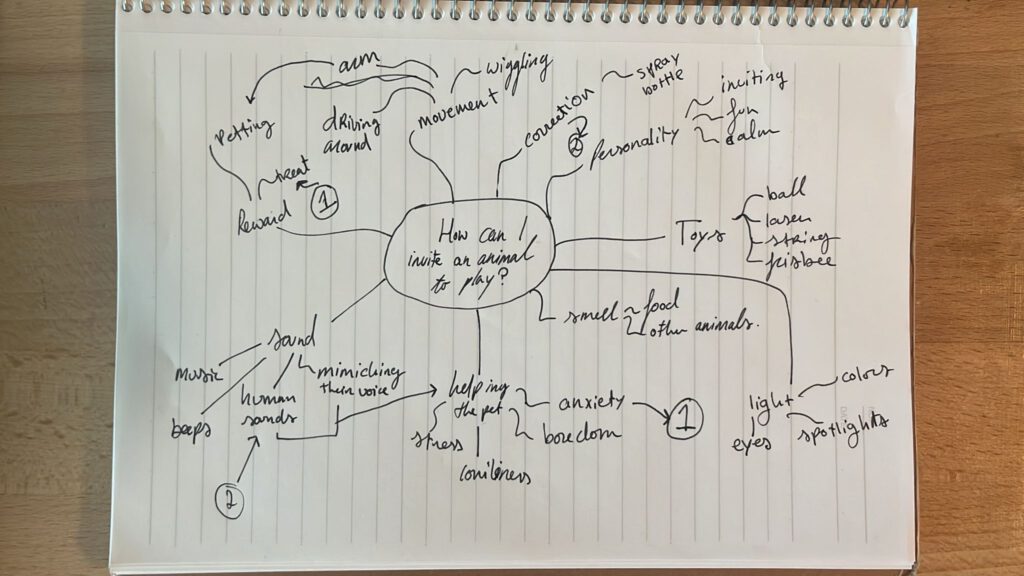
Building Blocks & Functional Breakdown
Main Platform
- Controlled base from Alan (Figure 3): A sturdy chassis with lights and speakers
- Microcontroller: Arduino/Raspberry Pi to control the modular attachments
- Actuators: Servos and maybe an open-source arm structure (SO-ARM100) to manipulate object and toys
- Power supply: High-capacity battery pack safely enclosed (No chewing in batteries!)
Module Examples
- Arm/Kinetic movement (or just something simple for the tail or a laser pointer)
- Audio/Visual modules for entertainment or copying/mirroring the pet
- Reward module: Automatic controllable treat-dispenser
Sensor Input
- Microphone: To detect interactions (e.g., barking and/or purring)
- Proximity sensor: To detect when an animal approaches the robot
- Vision: A camera to detect the animal, toys or other objects
Potential Approach

Setup: To help actualise and map the encounter between the animal and the robot/technology, we will conduct a live play session using a domestic cat (played by Maurits) and a robot (played by Gijs). The team members will use a physical proxy (e.g., a cardboard cutout of a robot and a cat onesie) to intentionally restrict movement or speed, creating a more accurate representation of the interaction by simulating behaviour closer to the physical limitations. The rest of the team will support this play session using live music, camerawork for later research, and a live audience. Figure 4 is an example of how our actor would portray a seal.
Pitch
References
Core HRI/ARI literature
[1 [J. Abdai and A. Miklósi, “Poking the future: When should we expect that animal-robot interaction becomes a routine method in the study of behavior?,” Animal Behavior and Cognition, vol. 5, no. 4, pp. 321–325, Nov. 2018, doi: 10.26451/abc.05.04.01.2018. Available: doi.org/10.26451/abc.05.04.01.2018
[2] H. Väätäjä, S. Tapio, and J. Häkkilä, “Exploring Dogs’ Reactions when Encountering Delivery Robots in Urban Environment,” Association for Computing Machinery, pp. 350–353, Oct. 2023, doi: 10.1145/3616961.3617805. Available: doi.org/10.1145/3616961.3617805
[3] F. Correia et al., “Of Dogs and Robots: More Than Human Interactions at Play?,” ACM, pp. 547–551, Mar. 2026, doi: 10.1145/3776734.3794455. Available: doi.org/10.1145/3776734.3794455
[4] P. Mundell, S. Liu, N. A. Guérin, and J. M. Berger, “An automated behavior-shaping intervention reduces signs of separation anxiety–related distress in a mixed-breed dog,” Journal of Veterinary Behavior, vol. 37, pp. 71–75, May 2020, doi: 10.1016/j.jveb.2020.04.006. Available: doi.org/10.1016/j.jveb.2020.04.006
[5] C. Mancini, “Animal-computer interaction,” Interactions, vol. 18, no. 4, pp. 69–73, Jul. 2011, doi: 10.1145/1978822.1978836. Available: doi.org/10.1145/1978822.1978836
Adjacent field literature
[6] D. M. Fogelson, C. Rutledge, and K. S. Zimbro, “The Impact of Robotic Companion Pets on Depression and Loneliness for Older Adults with Dementia During the COVID-19 Pandemic,” Journal of Holistic Nursing, vol. 40, no. 4, pp. 397–409, Dec. 2021, doi: 10.1177/08980101211064605. Available: doi.org/10.1177/08980101211064605
[7] S. Y. Okita, “Self–Other’s perspective taking: The use of therapeutic robot companions as social agents for reducing pain and anxiety in pediatric patients,” Cyberpsychology Behavior and Social Networking, vol. 16, no. 6, pp. 436–441, Mar. 2013, doi: 10.1089/cyber.2012.0513. Available: doi.org/10.1089/cyber.2012.0513
[8] M. Westerlaken and S. Gualeni, Becoming with: towards the inclusion of animals as participants in design processes, 3rd ed. 2016, pp. 1–10. doi: 10.1145/2995257.2995392. Available: doi.org/10.1145/2995257.2995392
[9] D. A. Norman, “Affordance, conventions, and design,” Interactions, vol. 6, no. 3, pp. 38–43, May 1999, doi: 10.1145/301153.301168. Available: doi.org/10.1145/301153.301168
[10] S. Greenberg and C. Fitchett, Phidgets. 2001, pp. 209–218. doi: 10.1145/502348.502388. Available: doi.org/10.1145/502348.502388

No Comments.