
Collaborators
We worked on this assignment with Maurits Dijkman, Bianca Filip, Ewoud Janus, Emilia Pavel, and myself of course. During this session I was feeling somewhat under the weather so my contribution was not as extensive as I would have liked. I was mostly trying to support the others to the best of my ability at the time.
Tool design
In the previous sessions we have explored the interaction, embodiment, ethics and movement of our tool, for this session the focus was on creating a tool that will help us make informed decisions on the actual behavior of the robot for our case. In this close to last session we laid the final groundwork for our final toolkit.
The tool we developed for this session is a lo-fi card-based tool that should be useful in designing the behavior of the robot. The tool is broken up into five individual steps displayed on cards. These cards should help the designer break down the intended scenario down in the smaller moments in the interaction.
These steps are as follows
- Step: At what moment is the scenario happening?
- Sense: What should the robot detect?
- Think: How should the robot interpret or make a decision?
- Act: What should the robot do?
- Issue: What can possibly go wrong?
In Figure 1 you can see the concept structure we designed for our tool, we broke down the flow and different steps for the tool. On this sheet you can also see how the tool would apply to our case and the Alan robot. We made choices on what hardware the robot would possibly need, and how its behavior should be. Because the tool forces you to break up the entire behavior into multiple different steps, we found that it makes it easier to discuss and explore the different options for the behavior.
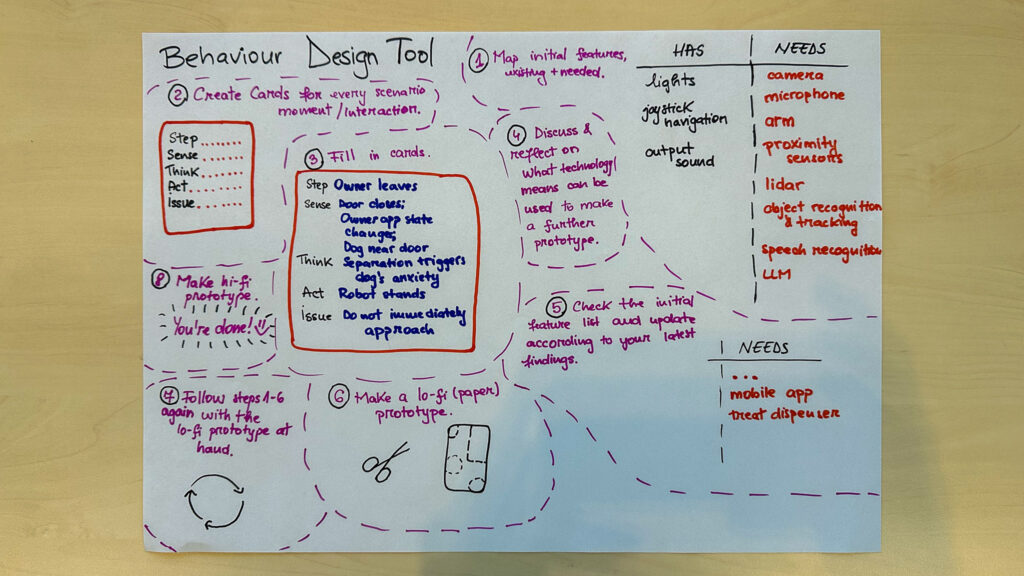
Applying the tool to our case
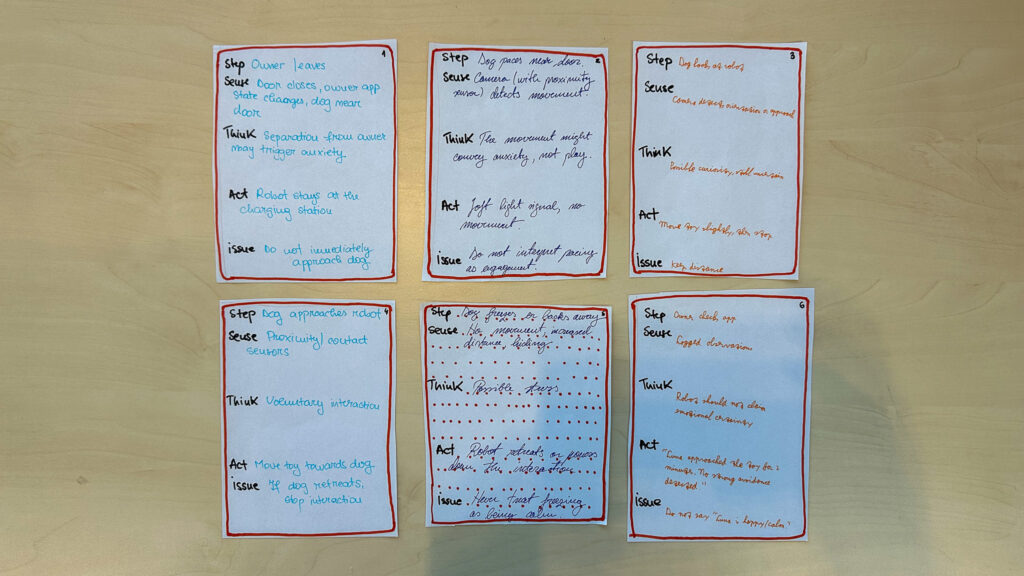
We of course also applied the tool we created to our case, the Alan robot helping the anxious dog that is left at home after the owner leaves become relaxed and comfortable. Figure 2 shows the cards that we filled out in the context of our case, the owner leaves the house, and the dog starts anxiously waiting near the door. The six cards all contain the most important behaviors we believe the robot needs to realize.
Card one describes the moment when the owner leaves the house. Alan should sense that the door has closed, the owners app sends a signal that they left, and the dog starts waiting at the door. Alan should know that due to the owner leaving the dog enters an anxious state. At this moment Alan should decide to patiently wait at its charging station instead of immediately starting an interaction.
Card two describes the moment where the dog starts anxiously pacing at the door. Alan should detect this movement through its camera or proximity sensor. It should interpret the dog's behavior as anxious and conclude that the dog might not yet be in a mood to play. Alan should provide a soft light, signaling that it's there, but not actively moving to the robot.
Card three describes the moment the dog notices Alan. Alan should sense the possible curiosity of the dog, but it should still be careful as not to startle the dog. Alan should start very slightly moving towards the dog, but while still keeping its distance. The dog should decide when to fully start the interaction.
Card four describes the moment the dog approaches Alan. Alan should sense the dog's proximity. It should interpret this as a voluntary start of an interaction. Alan should present the toy, and move slightly closer to the dog. If it notices that the dog has changed its mind and retreats, Alan should disengage and stop the interaction.
Card five describes the moment the dog freezes or backs away from Alan. Alan should sense this hiding/freezing movement. It should interpret this as possible fear for the robot, Alan should retreat and stop the interaction. The risk is that Alan interprets the lack of movement as relaxation in the dog.
The final and sixth card describes the moment the owner checks on Alan in the app. Alan uploads observations of the dog's behavior. Alan should not claim overconfidence on the interpretation of the dog's emotional state or behavior. The action it should perform is communicate the behavior it sensed and why, as it might interpret the dog being happy, while in actuality it may be angry.
HRI/ARI Grounding and Reflection
The "Sense-Think-Act" breakdown of the behavior in this tool is based on fundamental robot control theories. It is heavily based on the work of Brooks, who proposed the Subsumption Architecture, which emphasizes that complex behavior can be formed by layering simple, dynamic sub-systems. Because we follow the "Sense-Think-Act" steps on the cards we can ensure that the robot has a dynamic and robust behavior system that can adapt in real time to the dogs behavior and needs.
This tool and session helped us effectively break down the different behaviors that Alan needs for our case. We especially found that such an autonomous robot would need close to a human level of emotional intelligence, as a system that is too rigid might misinterpret the dog's behavior. This is why Alan should communicate its observations rather than the conclusions it has made to the owner. Allowing the owner to understand Alan's thinking and provide it with the right instructions for its behavior at the right time.
This session I believe also exposed a flaw in our design process thus far. It made it clear that testing this system on a real dog would be highly risky, because if something were to go wrong during the interaction we might scar the robot for the rest of its life. This helped us realize that we should shift focus more to a toolkit design that is focused on developing these behaviors and interactions in a more structured and safe way, by employing humans as a dog substitute.
References
R. Brooks, “A robust layered control system for a mobile robot,” IEEE Journal on Robotics and Automation, vol. 2, no. 1, pp. 14–23, Jan. 1986, doi: 10.1109/jra.1986.1087032. Available: https://doi.org/10.1109/jra.1986.1087032

No Comments.