We worked on this assignment with Maurits Dijkman, Bianca Filip, Ewoud Janus, Emilia Pavel, and myself of course. During this session I worked specifically on finding references and information on which aspects of a robot are important for developing a robot for dogs. I worked out the initial concept of the audio tool, which was then later expanded on in a group setting.
Why even have a physical robot?
While continuing working on the VR based tool we developed in an earlier session could be useful and easier to deploy to further the development for our tool, it would it our case not be the best solution. A modular toolkit that is aimed at alleviating anxiety in pets requires a physical embodiment. Below I will explain some points as to why this is important
Proxemics and Spatial Dynamics
A physical robot will occupy a tangible space within in the home environment, which will allow it to actively leverage proxemics. The work of Hall has defined spatial zones (ranging from intimate to public), a physical body will communicate the robots intent through its physical distance from its user. In the case of our anxious pet, the possibility to physically retreat from or approach the robot is a crucial communicative signal. A physical embodiment for the robot respects and makes use of these spatial boundaries in a way an application on a screen will not be able to.
Co-presence and Social Presence
Physical embodiment inherently provides a "co-presence affordance", which will change how the agent is perceived on a fundamental level. As the work of Wainer et al shows, sharing the same physical space significantly enhances the interaction between the robot and the user. The shared physical space generates a stronger sense of social presence, and will boost the perceived intelligence of the robot. For our companion toolkit the co-presence will transform our robot from an object into a "living" agent for the pet.
Functional Interaction
Besides the social and psychological signaling, a physical body is also simply required to perform its functional interactions with the environment and the pet. A software solution will be confined to a digital environment, but a physical robot will be able to actually interact with the pet and the owner. It will be able to perform tasks such as grabbing, throwing and navigating through the environment. Because our toolkit requires the robot to provide treats and move with and around the pet, it just simply requires a physical form.
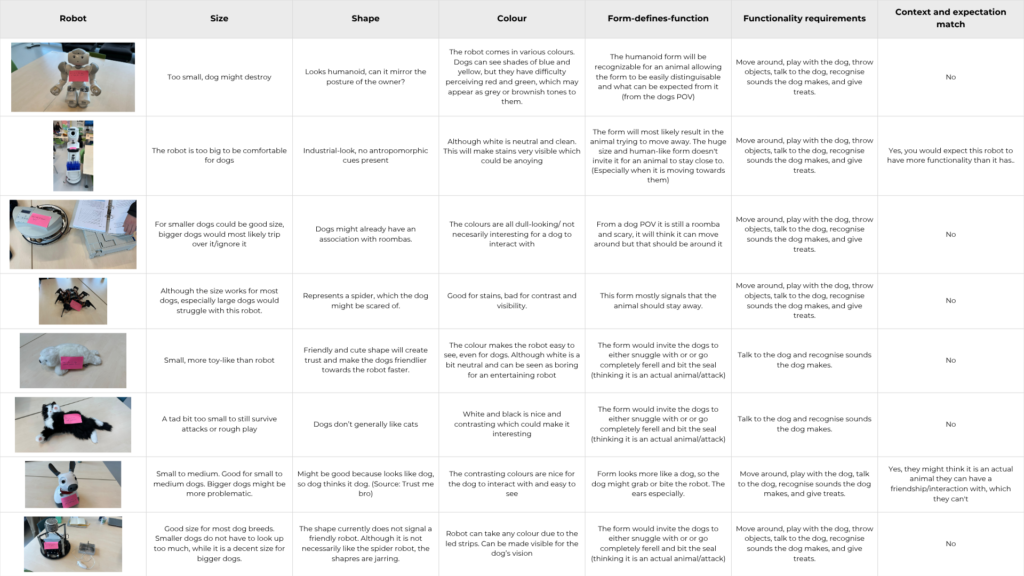
Morphological matrix overview
Figure 1 - Investigation of robot selection from course
To get an overview of the possibilities and affordances of the robots that are providing the disposable cases, we created a matrix in which we compare these robots. We set out to explore what the physical form of the robots tell us about their use and applicability to our case. The most important column is the last one ("context and expectation match"), this column would mostly determine whether we believe the affordances within the robots shape matches their context and what we expect from their abilities. In the end we settled on keeping to our original robot Alan, as we saw great opportunities for it. Alan should provide us with a solid base on which we can expand its capabilities to our needs. Importantly we wanted to create a robot that under promises on its capabilities and overdelivers on its actual performance. The shape should not be too sci-fi, but also not too toy-like.
Tool Design
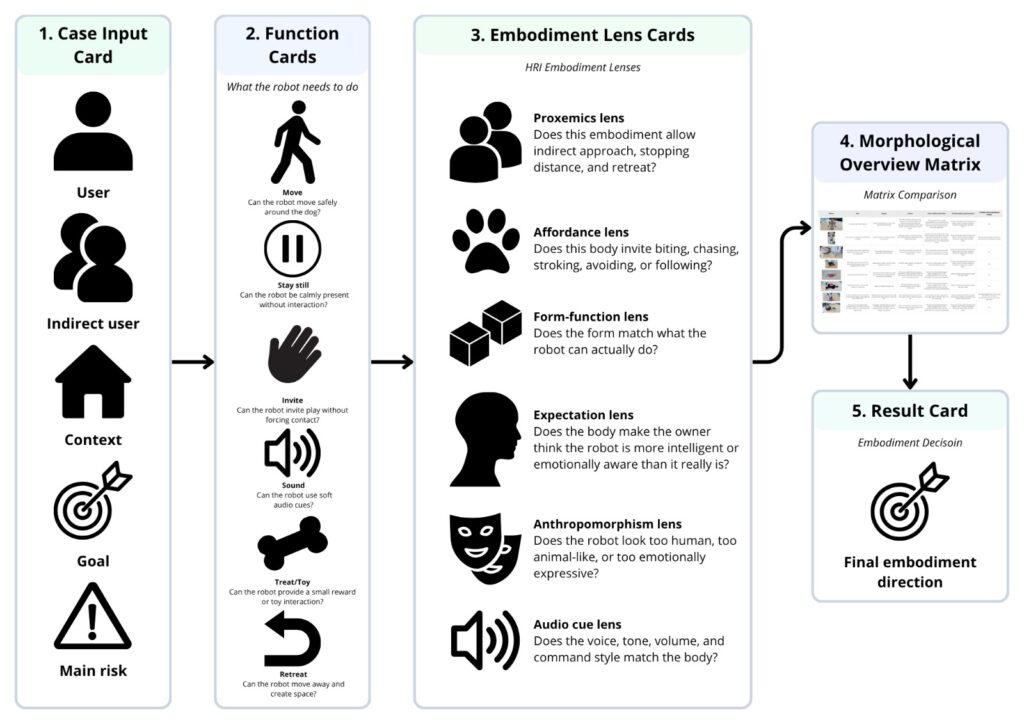
The tool we created during the session is called the embodiment Fit Tool. The tool is a collection-based and matrix-based design tool for making choices about the embodiment of their social robot. The tool provides designers with a framework to compare options for the robots embodiment. With the tool they can compare the shape of the body, its size, color, affordances, expectation match, and its audio behavior.
The initial concept for our tool focused specifically on the audio behavior. This tool would allow the user to create and test different types of voices and commands for the pet, with the possibility of changing inflection, volume, etc. We later discussed that this solution would not fully answer the embodiment question from this session. Therefore it was expanded to the Embodiment Fit Tool containing cards to guide the process as seen in Figure 2.
Figure 2 - Embodiment Fit Tool
How the tool works and the application to our case
Step 1 - Case Input card
This first card will decide and define the context in which the robot is used. The direct user will be the anxious dog, the indirect user is the owner, the context is the owners apartment and them being away from home. The goal for the robot is to create a low-pressure interaction without making the dog more anxious. The main risk is that the robot becomes too intimidating or too excited.
Step 2 - Function cards
The function cards will help determine the actual tasks of the robot. For our case the most important functions are as follows: navigating around the space, being a calm and safe presence, inviting play, making sounds, and providing a treat or toy to the pet. Importantly the robot should also adapt to the pet while performing its functions.
Step 3 - Embodiment Lens cards
The embodiment lens cards helps translate HRI/ARI knowledge into design questions. Each of the options is judged through the lenses of proxemics, affordances, form-function match, expectation, anthropomorphism, and the audio cue. The proxemics lens asks how and at what distance the robot should approach the pet and the owner for example.
Step 4 - Morphological overview matrix
The morphological overview matrix allows us to plot the different the different options that were created in the previous steps in a systematic way. This allows us to compare the different options in a more systematic and objective way.
Step 5 - Result card
The final card will summarize the chosen embodiment direction. For our case we chose the Alan robot, as explained before, we see it fit as a base to expand upon. We do need to add some components onto the robot. It will need a shell to protect its components from the pet, but also to protect the pet from electrical shock. The shell will also work towards providing the robot with the right affordances and matching its shape to the right expectations.
Evaluation and reflection
The main insight that we got from applying this tool, and specifically the morphological matrix is that none of the available robots would fit our case correctly. Where the "Scenario Design Tool" session forced us to focus on the interaction requirements for our case, this session pulled us back to the physical form. Although for me personally the concept of affordances and how the physical shape communicates function was not new, it was still important to focus on this for our case. The session/tool changed our case in that it forced us to get a good understanding of how we want to shape the embodiment for our toolkit and its subsequent requirements.
References
Wainer, J., Feil-Seifer, D. J., Shell, D. A., & Matarić, M. J. (2006). The role of physical embodiment in human-robot interaction. In Proceedings of the 15th IEEE International Symposium on Robot and Human Interactive Communication (pp. 117–122). IEEE. https://doi.org/10.1109/ROMAN.2006.314404
E. T. Hall, The hidden Dimension. National Geographic Books, 1990.
To provide the best experiences, we use technologies like cookies to store and/or access device information. Consenting to these technologies will allow us to process data such as browsing behavior or unique IDs on this site. Not consenting or withdrawing consent, may adversely affect certain features and functions.
Functional
Always active
The technical storage or access is strictly necessary for the legitimate purpose of enabling the use of a specific service explicitly requested by the subscriber or user, or for the sole purpose of carrying out the transmission of a communication over an electronic communications network.
Preferences
The technical storage or access is necessary for the legitimate purpose of storing preferences that are not requested by the subscriber or user.
Statistics
The technical storage or access that is used exclusively for statistical purposes.The technical storage or access that is used exclusively for anonymous statistical purposes. Without a subpoena, voluntary compliance on the part of your Internet Service Provider, or additional records from a third party, information stored or retrieved for this purpose alone cannot usually be used to identify you.
Marketing
The technical storage or access is required to create user profiles to send advertising, or to track the user on a website or across several websites for similar marketing purposes.


No Comments.